

(SeaPRwire) – On Monday, Iran turned down ceasefire proposals for its five-week conflict with the U.S. and Israel, instead demanding “a permanent end to the war,” per Iran’s official state news agency IRNA.
Iran stated it relayed this rejection to the U.S. through Pakistan, and the move comes just before U.S. President Donald Trump’s deadline to target Iran’s power facilities and transportation infrastructure.
IRNA noted: “This ten-paragraph response from Iran, drawing on past experiences, rejects a ceasefire and stresses the need for a permanent war end that honors Iran’s concerns.”
IRNA further stated Iran’s response includes demands like “ending regional conflicts, a safe passage protocol for the Strait of Hormuz, reconstruction [war damage reparations], and sanction relief.”
In reaction to U.S. and Israeli strikes, Iran has effectively shut down the Strait of Hormuz—a key waterway linking the Persian Gulf and Gulf of Oman that carries roughly 20% of the world’s oil output.
The Strait’s closure, along with air and missile attacks on oil and gas facilities on both Gulf coasts, caused a steep jump in global gas and fuel prices, with increases of up to 20-30% at gas stations in the U.S. and Europe.
On April 6, the U.S. oil benchmark West Texas Intermediate reached $115.48 per barrel (a 3.5% increase), while Brent crude rose to nearly $112 per barrel.
Trump rejects Iran’s proposal
Trump—who had warned he would unleash “hell” on Tehran if it failed to strike a deal by 8 p.m. EDT Tuesday to reopen the critical global energy route—turned down Iran’s proposal.
“They submitted a proposal—it’s a major one, a big step—but it’s not sufficient,” Trump told reporters Monday during the annual White House Easter gathering.
Though Iranian officials haven’t publicly commented on the talks’ progress, state media reports that Foreign Minister Abbas Araghchi has spent the past 72 hours in a series of phone calls with his counterparts from India, Russia, Turkey, Japan, Qatar, France, Egypt, and Pakistan—some of whom are reportedly serving as intermediaries in U.S. talks.
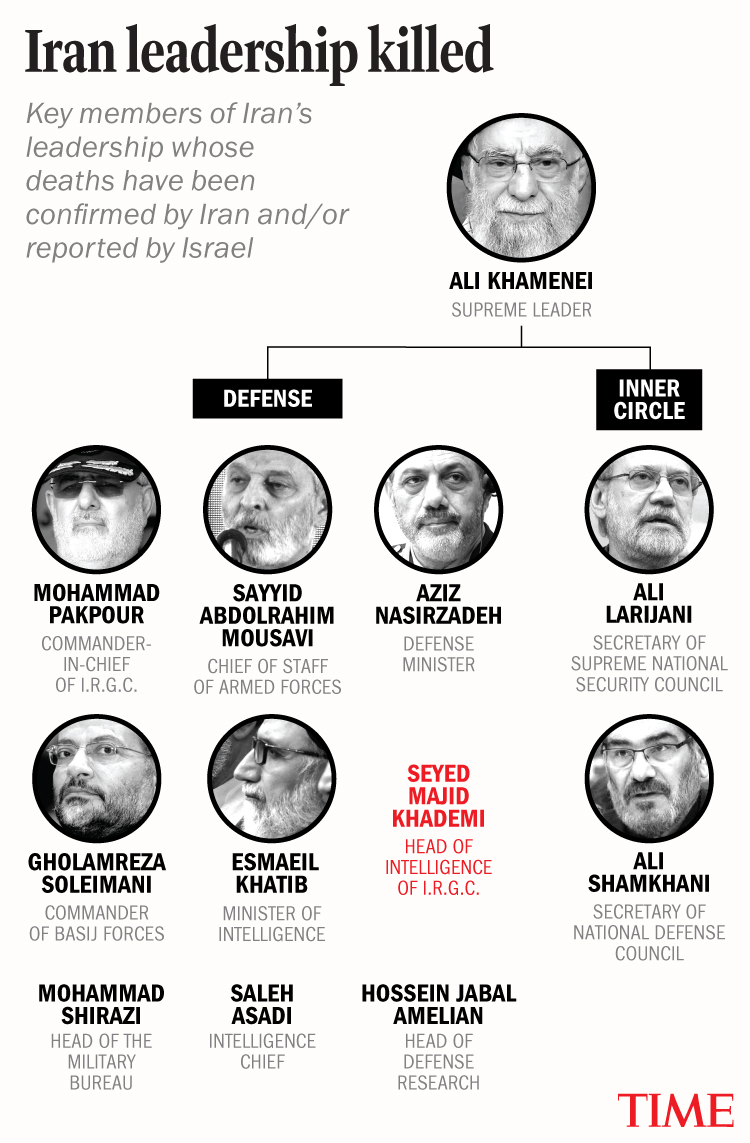
Israel says it killed Islamic Revolutionary Guards intelligence chief
On Monday, Israel announced it had killed Majid Khademi, the intelligence chief of the Islamic Revolutionary Guards, in airstrikes on Iran.
“Major General Majid Khademi—powerful, learned head of the Intelligence Organization—was martyred in a criminal, terrorist attack by the American-Zionist enemy during the Third Imposed War early this morning,” the Guards stated in a release carried by the semi-official Fars News Agency.
The Guards’ intelligence body, known as SASP, was expanded from a military counterintelligence unit into a robust intelligence agency in October 2009. This move came at the behest of Iran’s former supreme leader Ayatollah Ali Khamenei, following the 2009 Green Movement protests against the regime.
Over time, it grew in power and scope, becoming a rival to VAJA—the Islamic Republic’s intelligence ministry, which was formally under the president’s authority and answerable to parliament. This constraint didn’t apply to SASP’s head, who was directly appointed by the supreme leader and only accountable to him.
Eventually, it became the state’s main intelligence body and the go-to tool for suppressing dissidents and regime critics.
Khademi had taken over from Mohammad Kazemi, the previous head, who was killed in Israeli airstrikes on June 15, 2025—during the U.S.-Israeli attack on Iran known as the 12-day war. But it’s uncertain how much the killing of SASP’s chief will weaken the state’s ability to coerce and persecute.
“As we saw earlier, the death of the Guards’ intelligence chief didn’t significantly impact their ability to crack down on protests. Just a few months later, they violently quelled the millions who protested in January,” an Iranian-based analyst told Time.
“The Guards have built a layered command structure across all their departments and bodies, so if a commander is killed, a subordinate is ready to step in right away,” he continued.
Petrochemical plants and universities targeted in strikes
The strike on the Guards’ intelligence chief wasn’t the only one that night. Iran’s Health Ministry reported seven children under 10 were killed in strikes across the country, including a baby under 12 months old.
Sharif University of Technology— Iran’s top engineering school in the 92-million-person nation—was also struck by airstrikes, damaging some of its most advanced departments.
“The High-Performance Computing department and Information and Communication Technology Center were destroyed. This means the theses and research of hundreds of students—including some of the country’s top minds—were lost,” said an engineering professor at a Tehran university, who (like other Time interviewees) asked to remain anonymous due to fear of retaliation.
Industrial targets were also heavily targeted, with petrochemical plants in the South Pars Gas Field (the world’s largest, located in Asalouyeh) bearing the brunt of the strikes.
“The Mobin and Damavand utility plants— which supplied water, electricity, and oxygen to Asalouyeh’s petrochemical facilities—were hit,” the semi-official Tasnim News Agency reported, noting that the region’s petrochemical plants will have no electricity until the utility plants are fixed.
Local media also reported that the Marvdasht industrial park near Shiraz was targeted, with the Marvdasht Petrochemical Plant’s electricity utility facility struck, per a statement from the Marvdasht governorate.
This article is provided by a third-party content provider. SeaPRwire (https://www.seaprwire.com/) makes no warranties or representations regarding its content.
Category: Top News, Daily News
SeaPRwire provides global press release distribution services for companies and organizations, covering more than 6,500 media outlets, 86,000 editors and journalists, and over 3.5 million end-user desktop and mobile apps. SeaPRwire supports multilingual press release distribution in English, Japanese, German, Korean, French, Russian, Indonesian, Malay, Vietnamese, Chinese, and more.

