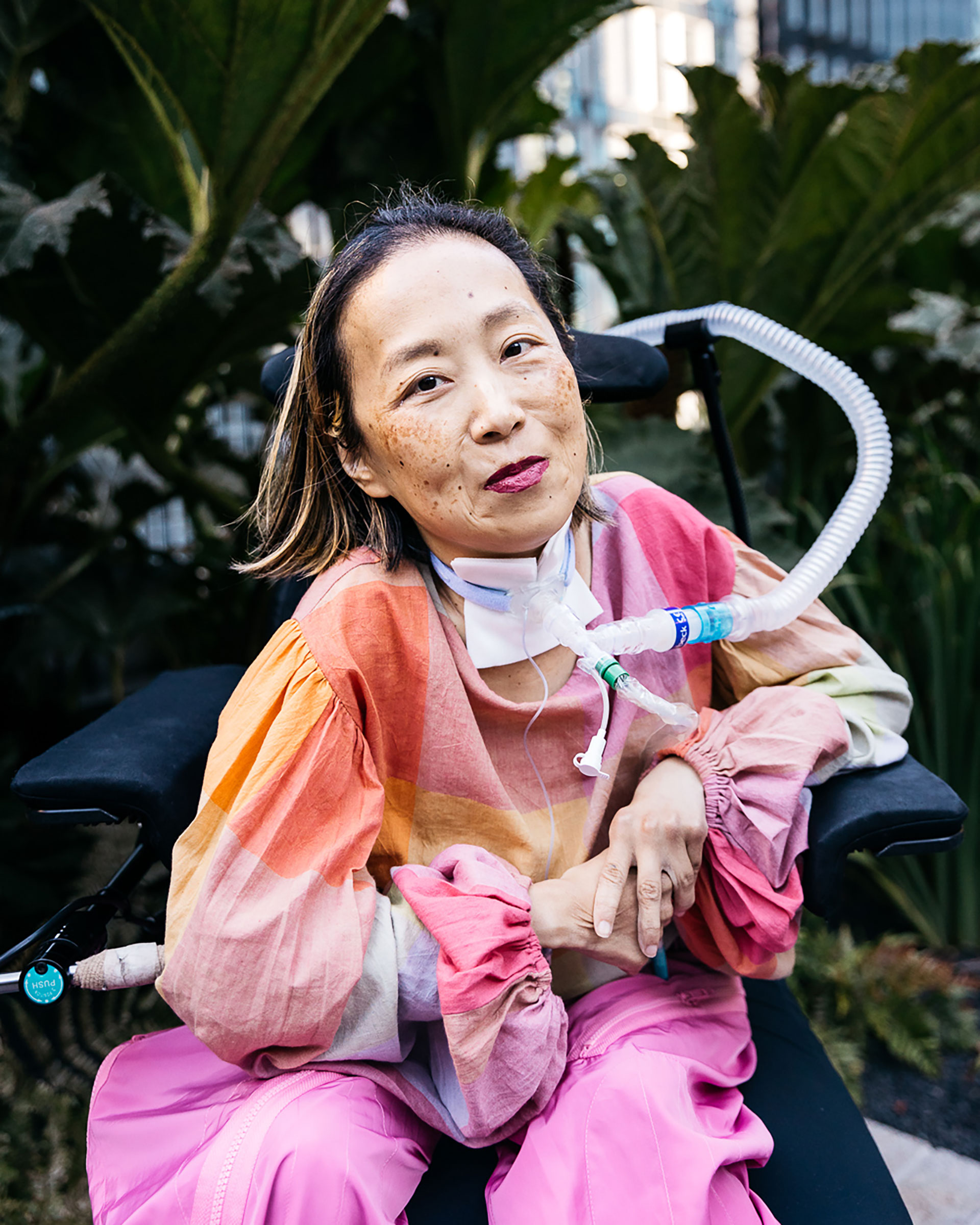
On November 14, the disability justice activist, writer, and Alice Wong passed away in San Francisco. She was 51 years old.
In the life of Alice Wong, there was always a blending of anger and love: “I’m honored to be your ancestor and believe disabled oracles like us will light the way to the future. Don’t let the bastards grind you down. I love you all.”
I first immersed myself in Wong’s writings as my disabled political identity began to develop and I experienced significant chronic pain. Upon returning to college in 2022, I immediately contracted COVID-19 for both the first and second times. I felt ashamed for my anger—regarding the removal of COVID-19 protocols, the reactions from certain students and faculty, and developing long COVID after two individuals knowingly walked around unmasked on the third day of their infection.
When I read Wong write, I understood.
One of my final cherished memories from college is a photo of me leading my first-ever book club: I wore a KN95 mask, ready to facilitate a discussion on the intersections of Asian American identity and disability, and enthusiastically held a copy of Wong’s memoir, .
On anger
Wong was born in Indianapolis, Indiana, in 1974 to Henry and Bobby Wong, immigrants from Hong Kong. As a young child, she was diagnosed with a form of muscular dystrophy, a neuromuscular disease affecting mobility, breathing, and muscle strength.
Her family and friends provided profound support. However, when recalling old photographs, Wong remembered “moments of anger and frustration.” Her memoir recounts stories of blatant discrimination, pressure to be grateful, encouragement to “get better,” and an Evangelical revival that concluded with churchgoers fawning over her seemingly newfound ability to take a few steps—an ability Wong possessed without the power and spirit of the Almighty.
Non-disabled people do not anticipate anger. Loneliness, gratitude, and quiet resilience are the only emotions we are permitted to show. However, as Wong expressed in numerous tweets, blog posts, essays, and talks, “f— that s—!”
Wong maintained her anger, channeling it and often transforming it into a profound love for her communities. She wrote in her memoir, “I channeled the anger and frustration that I could not articulate and understand as a child into writing and research about the disability experience as an adult. It was the beginning of my odyssey in disability research and activism.”
I refused to be alone; Wong’s discontent inspired me to convert my own anger into a drive to find and participate in supporting disabled communities locally, online, and internationally.
On rights
Between 2013 and 2015, Wong, , an independent federal agency advising the U.S. government on legislation and policies affecting people with disabilities. Wong advanced disability rights and political involvement by co-founding with activists.
She recognized the practical benefits of disability rights, but her work also contained a clear desire to connect, reaching those overlooked by federal policies or subjected to their structural violence. Wong fiercely opposed that limited our rights to health and privacy. She was a strong advocate for. She coordinated collaborative efforts with with and, and Wong saw, mobilizing her community to gather to help.
Wong insisted on an intersectional, actionable advocacy that drew from the collective anger of the disabled community, funneling rage into justice.
On connection
In the introduction of Disability Intimacy: Essays on Love, Care, and Desire, an anthology edited by Wong, she recounted encountering the question, “Can people with disabilities find love?” Wong responded with “Ewwwwww,” and called it “basic AF.”
She refuted a reality where disabled individuals are unable to experience the full spectrum of love. Love can be love, can be the intimacy found in, can be the threads of care and connection forged across continents, as seen in Wong’s most notable endeavor: the. Collaborating with StoryCorps, Wong initiated the project to record approximately 140 oral histories of disabled oracles and archive them at the Library of Congress.
Since its inception in 2014, the Disability Visibility Project has featured essays, blog posts, interviews, and collectives focused on disability justice. In true Wong-ian fashion, the Disability Visibility Project has established a home in, alongside her renowned X posts and, and the literature persists in anthologies like and . Wong’s “genius grant” will continue her efforts to platform disabled stories well into the afterlife.
On Alice
An activist’s life is never solitary, and Alice Wong’s legacy endures. The page, originally created to assist with Wong’s medical expenses, is now raising funds to continue her work.
In the worlds she helped to shape, there might be a cyborg-like contraption for the disabled oracles of past, present, and future to witness the care networks and commotions, the love and anger we cultivate in their wake. I have learned from Wong that to be angry is to be unapologetically angry. Let it propel us forward, transform into or exist alongside boundless love. In her words, “Just hang in there, keep reading, and.”

